Albert Ellis, the Epicurean? Exploring an Underappreciated Side of REBT

That modern cognitive behavioral therapy (CBT) is indebted to ancient Stoicism is rather well-known at this point.
Albert Ellis, founder of rational-emotive behavioral therapy (REBT), the first cognitive psychotherapy, quotes the Stoic philosopher Epictetus prominently in his writing, particularly the famous line, “men are not disturbed by things, but by the views which they take of them” (Ellis, 1962, 54).
But what if Albert Ellis actually has a greater affinity with another Hellenistic philosophical school: Epicureanism?
Let’s take a brief look at three aspects of Epicurean ethics and see how they compare to Ellis’ views in his foundational 1962 book Reason and Emotion in Psychotherapy.
Hedonism
Epicureans are hedonists, that is, they believe that pleasure is the sole good in life. Epicurus, founder of Epicureanism, writes:
For we recognize pleasure as the first good innate in us, and from pleasure we begin every act of choice and avoidance, and to pleasure we return again, using the feeling as the standard by which we judge every good (Epicurus, Letter to Menoeceus [LTM], 129).
Ellis commits to hedonism as well, writing:
[P]leasure or freedom from pain is a principal good and should be the aim of thought and action […] The rational-emotive therapist […] tries to help his patients adopt a workable hedonistic way of life (Ellis, 1962, 363).
Pleasure as absence of pain
Epicurus takes an idiosyncratic view of pleasure. For him, pleasure is identical to absence of pain (Epicurus, LTM, 128). For the Epicurean, in fact, the absence of pain is the limit of pleasure. Epicurus writes:
The limit of quantity in pleasures is the removal of all that is painful (Epicurus, Principle Doctrines [PD], 3).
Although there is some ambiguity in his language, Ellis also seems to hold the view that pleasure is identical with absence of pain. Returning to the quote above, Ellis writes:
Just about all existing schools of psychotherapy are, at bottom, hedonistic, in that they hold that pleasure or freedom from pain is a principal good and should be the aim of thought and action (Ellis, 1962, 363).
Here, when Ellis states that “pleasure or freedom from pain is a principle good,” he appears to be treating pleasure and freedom from pain as one in the same — a single, principle good – just like Epicurus.
Rational-emotive therapy […] invites a long-range hedonistic approach to satisfaction that emphasizes the pleasures and lack of pain of tomorrow as well as the satisfactions of today (Ellis, 1962, 333).
Here again Ellis seems to treat pleasure and lack of pain as a single aim.
Prudential hedonism
While Epicurus believes pleasure to be the proper standard for all practical decision-making, he advocates a prudential form of hedonism that involves eschewing many immediate pleasures when they are likely to result in longer-term pains:
And since pleasure is the first good and natural to us, for this very reason we do not choose every pleasure, but sometimes we pass over many pleasures, when greater discomfort accrues to us as the result of them; and similarly we think many pains better than pleasures, since a greater pleasure comes to us when we have endured pains for a long time. Every pleasure then because of its natural kinship to us is good, yet not every pleasure is to be chosen; even as every pain also is an evil, yet not all are always to be avoided. Yet by a scale of comparison and by the consideration of advantages and disadvantages we must form our judgment on all these matters (Epicurus, LTM, 129).
Ellis also advocates a prudential hedonism, which he calls long-range hedonism. He writes:
[W]hat I call long-range or socialized hedonism— that is, the philosophy that one should primarily strive for one’s own satisfactions while, at the same time, keeping in mind that one will achieve one’s own best good, in most instances, by giving up immediate gratifications for future gains (Ellis, 1962, 134).

So, Albert Ellis, the Epicurean?
We’ve reviewed a few key similarities between the ethics of Epicureanism and Albert Ellis: each takes pleasure to be the proper aim of all thought and action; each views pleasure as the absence of pain; and each advocates a prudential hedonism in which one ought to pass over many immediate pleasures for the sake of greater, longer-term pleasures.
These three positions perhaps put Ellis closer to Epicureanism than even to Stoicism, at least on questions of ethics, even if he does put heavy emphasis on the Stoic insight that we are not disturbed by things but our judgments about them (and that’s not to say that Epicureans don’t have their own rationally-based therapeutic methods — they do).
Curiously, Ellis writes:
RT [rational therapy], while embracing neither the extreme views of the Epicureans nor those of the Stoics, strives for a more moderate synthesis of both these ways of life (Ellis, 1962, 364).
This comes on the tail of his writing that “the short-range hedonistic philosophy of ‘“Drink, eat, and be merry, for tomorrow you may die,”’ is unrealistic” (Ellis, 1962, 363) and represents the only time he explicitly mentions Epicurean philosophy in his landmark work. This leaves the reader with the impression that he attributes the ‘drink, eat, and be merry’ brand of hedonism to the Epicureans – a common but obvious mistake (see, e.g., Epicurus, LTM, 131–132: “For it is not continuous drinking and reveling, nor the satisfactions of lusts, nor the enjoyment of fish and other luxuries of the wealthy table, which produce a pleasant life […]”).
While Eliis writes often of his affinity for Stoicism (e.g. 1962, 35, 54, 361), he notes elsewhere that he finds the Roman Stoic Marcus Aurelius’s fatalism to be extreme (1962, 362). So, this appears to be the extreme he seeks to avoid regarding Stoicism. Meanwhile, the extreme he seeks to avoid regarding Epicureanism is actually a fallacy, suggesting that his ethical position is perhaps closer to classical Epicureanism than his comment indicates — and possibly more than even he is aware.
Further, he endorses what he calls “the Stoic principle of long-range rather than of short-range hedonism” (Ellis, 1962, 363). This is a jarring statement, given that long-range hedonism is emphatically more Epicurean in spirit than Stoic. Stoics are no hedonists.
It’s hard to know what to make of this picture. Perhaps he was writing about these philosophies based on memory and not with the texts on-hand, and because of this he got a few things mixed up. If so, it is possible, however speculative, that this confusion obscured actual Epicurean influence on Ellis. Then again, given the paucity of explicit engagement with Epicureanism in this work, especially as compared to Stoicism, it is possible that he didn’t know much about Epicureanism after all and just happened to hit on many of the same ideas that they did.
Whatever the case, the similarities between the ethics of Epicureanism and Ellis is a topic that deserves more attention than it has received, especially since the inspiration he took from Stoicism has garnered so much interest.
Therapy for Work Stress in Virginia
If you’re feeling conflicted, stressed, burnt out, anxious, hopeless, exhausted, or stuck in your career, you can feel better.
You need a non-judgmental place where you can learn to use real tools to reduce stress, anxiety, burnout, and depression to get to clear-headed decisions, and make positive change in your life.
Change is hard, and taking the first step towards change can be the hardest of all. But you can enjoy your life again with a different kind of therapy that is innovative, evidence-based, and informed by practical philosophy.
If you are in the state of Virginia and would like therapy to help with career stress, I’m currently accepting new clients. Learn more about therapy for career stress in Virginia.
Ready for Things to feel easier?
Schedule Your First Therapy Session Today
You don’t have to figure it all out on your own. When you’re ready, I’ll help you sort through the heavy things and move toward real, positive, and lasting life change.
10+ Years Helping Clients | Therapist Midlothian, VA | Online Across Virginia
References:
Ellis, Albert. 1962. Reason and emotion in psychotherapy. Stuart.
Epicurus. (1926). Epicurus: The extant remains (C. Bailey, Trans. & Ed.). Clarendon Press.
Photo:
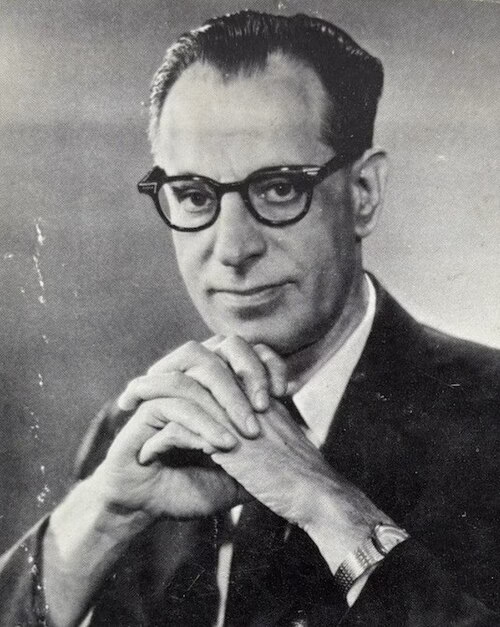
Albert Ellis, photographer unknown. Public domain via Wikimedia Commons.